
Dissection and molecular structure are two of the hardest parts of the high school science curriculum to teach well. One depends on specimens, prep time and lab space: the other asks students to picture 3D shapes from flat textbook diagrams. Two new modules in EduverseSTEM, Dissection Lab and Molecular Builder, turn both into something students can handle themselves
Both are built by AttainXR a USA-based company that develops interactive learning products designed to support schools in STEM and Career and Technical Education. AttainXR’s partnership with ClassVR’s creators, Avantis Education, began in May 2026 and has expanded into a full content partnership for ClassVR’s latest release, EduverseSTEM – bringing the Dissection Lab to the Biology library and the Molecule Builder to the Chemistry library, available through an EduverseSTEM license.
Building on AttainXR’s existing immersive learning simulations, these applications have been adapted and developed specifically for ClassVR Xcelerate.
Below, we’ve broken down each module, the impact this content has on learning, and how they can be used in your Biology and Chemistry lessons.
1. Biology – Dissection Lab
Designed for high school Biology lessons, supports NGSS HS-LS1-2 (interacting systems in multicellular organisms)
Using ClassVR Xcelerate, headsets that tracks full movement so students can lean in, move around and handle the specimen, students can virtually dissect five specimens in the Dissection Lab: earthworm, frog, clam, perch, and crayfish: examining anatomy, internal systems, and dissection technique in a safe virtual environment.
This gives students the chance to explore anatomy and carry out virtual dissections in an immersive setting, opening up experiences that can otherwise be difficult or costly to deliver in a traditional classroom.
How does a virtual dissection lab fit within a classroom?
Dissection has long been a staple of biology lessons, with the vast majority of US students encountering it at some point before graduation. That’s starting to shift. More than 20 states now give students the right to opt out of animal dissection, but without an alternative, that often means missing out on hands-on learning altogether and falling back on videos or textbook diagrams instead. VR offers a real alternative, giving students the chance to learn by doing, in an environment they feel comfortable in.
There’s also a growing body of research behind this shift. Studies comparing VR to traditional dissection methods have found students learn just as well, and in some cases better, using virtual alternatives, while also reporting higher engagement and enjoyment. In one anatomy VR study, for example, 87.5% of students strongly agreed they enjoyed dissecting and reassembling a heart in VR.
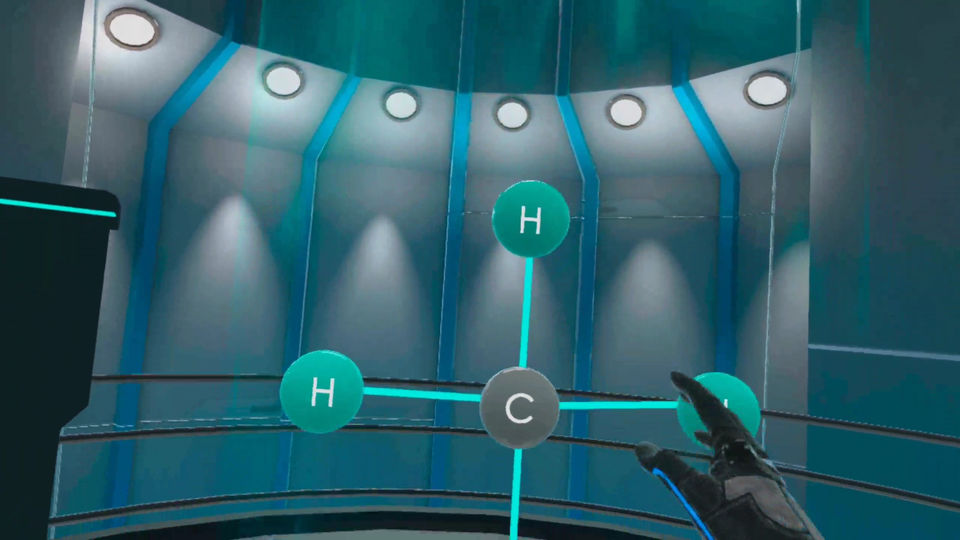
How to use a virtual dissection lab in the classroom:
- Pre-lab warm-up: let students explore the virtual specimen before a physical dissection lesson, so they arrive already familiar with the anatomy and spend lab time on technique rather than orientation.
- Full replacement for opt-out students: give students who opt out a way to meet the same learning objectives alongside their classmates, rather than sitting out with a worksheet.
- Repeatable practice: since nothing is consumed or damaged, students can redo a dissection as many times as needed to build confidence, and retain what they’ve learned.
- Small-group rotations: rotate small groups through the Dissection Lab as a station while others work on labeling diagrams or lab reports, then swap.
- Assessment tool: use the untimed, low-pressure format for anatomy quizzes or practical assessments without needing fresh specimens for every student or class.
2. Chemistry – Molecule Builder
Designed for high school Chemistry lessons, supports NGSSHS-ps1-1 ans HS-ps1-3
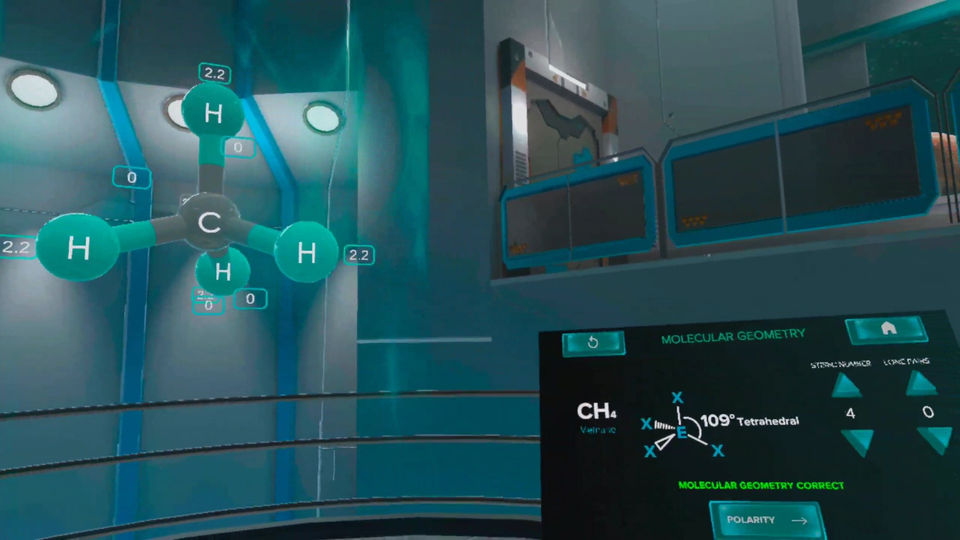
Using ClassVR Xcelerate, students can construct and manipulate molecular structures in 3D in the Molecule Builder, turning abstract, textbook-bound chemistry concepts into something they can build, rotate, and examine from every angle.
Molecular structure is one of the most complex subjects for students to visualize from a 2D diagram in a textbook; bond angles, spatial arrangement, and 3D shape are easy to describe but hard to truly picture. The immersive Molecule Builder bridges that divide, letting students construct molecules by hand in an immersive space and see, rather than just imagine, how atoms and bonds fit together.
How to use it in the classroom:
- Introducing bonding and structure — use it as a first hands-on step when teaching molecular geometry, letting students build simple molecules before tackling more complex 3D diagrams on paper.
- Building toward exam-style questions — have students construct a molecule in VR first, then draw or label the 2D structure from memory, reinforcing the link between the immersive model and the diagrams they’ll need to reproduce in assessments.
- Peer teaching — pair students up, with one building a molecule and describing it while the other guesses or draws it, reinforcing vocabulary like bond types and geometry.
- Differentiation — let stronger students move on to building more complex molecules independently, while others work through simpler structures with guided support.
- Station rotation — run it as one station in a rotation alongside worksheet-based problems or textbook diagrams, so small groups get hands-on time with even a small set of headsets.
- Revision tool — use it ahead of tests as a low-stakes way for students to rebuild and check their understanding of key molecules covered in the unit.
Bringing the AttainXR modules together in the classroom
Dissection Lab and Molecule Builder tackle the same problem from two directions: they take the parts of the science curriculum that are the hardest to see and turn them into something students can handle, take apart, and rebuild for themselves, without consumables, prep time or specialize lab space.
Making the lesson where each element is taught particle, in a way that doesn’t require consumables, prep time, or specialist lab space.
Want to learn more
Explore EduverseSTEM: browse the full Biology and Chemistry libraries and see what else is included with a license. https://www.classvr.com/eduversestem/
Book a demo: see Dissection Lab and Molecule Builder running on ClassVR Xcelerate with one of our education specialists. https://www.classvr.com/book-a-demo/
Learn more about AttainXR: discover the wider range of immersive STEM and CTE simulations AttainXR builds for schools. https://attainxr.com/