

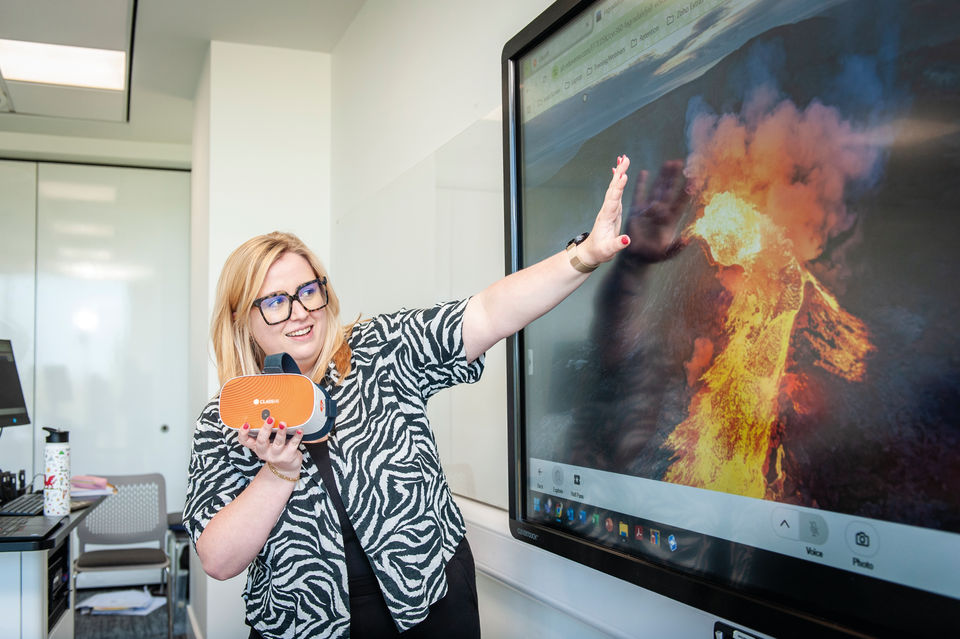
Two students study the Great Barrier Reef. One gets the textbook. Reads the chapter, answers the comprehension questions, moves on to the next topic.
The other puts on a VR headset. Suddenly they’re underwater. Coral polyps are feeding right next to them. A sea turtle drifts past, you see their jaw drop, they tilt their head up and there’s the surface, light bending and rippling above them, they feel like they are actually there.Each student gets tested on the same subject, when the results come back, the second student has a higher score, and the gap isn’t small. That’s what immersive learning does, and there is so much hard research that back it up.
What people mean when they say “immersive learning”
Forget the buzzwords for a second. The idea is dead simple: instead of students looking at content on a page or a screen, they feel like they are living it.
So a volcanic eruption? Not a paragraph with a cross-section diagram next to it. The student is on the rim, looking down at lava. That labelled heart from the biology textbook becomes something they physically walk through, blood cells moving past them, valves opening and shutting at eye level. All from the safety of their classroom.
What matters is what this does neurologically. Your brain processes “turning your head and having the whole environment respond” very differently to “watching a video on a screen.” The experience gets filed alongside real memories, things you did, places you went, rather than information you consumed. Neuroscientists have a term for this (embodied cognition, if you want to look it up), but the practical upshot is straightforward: students remember experiences far better than they remember pages.
A few different immersive learning technologies make this work. They’re not interchangeable, and picking the wrong one for a given lesson is where we see schools stumble.

Which technology fits which lesson
| Technology type | What it does | Classroom example | Best for |
| Virtual reality (VR) | Headset on, real world gone. Students move through a fully digital space | Ancient Rome walkthrough, solar system tour, lab safety rehearsal | Getting students somewhere they physically can’t go |
| Augmented reality (AR) | Digital stuff layered over the actual classroom | A 3D human skull sitting on a desk via an AR cube. Students pick it up, spin it around | Letting students handle objects that don’t exist (or are too fragile/expensive) |
| 360° content | Real locations captured in every direction, filmed or photographed | Rainforest canopy, the ISS, the middle of a coral reef | Taking a class somewhere real without leaving the building |
| Explorable scenes | VR environments where students wander freely and poke around | Forensics crime scene investigation, inside an active volcano | Self-paced discovery. Students find things at their own speed |
Geography lesson on the Amazon basin? 360° field trip. Cell division in biology? Students need to hold and pull apart a 3D model, that’s augmented reality. CTE students walking a hospital ward or welding shop? Explorable scenes. Pick the tool that fits the lesson. Sounds obvious, but you’d be surprised how often schools grab the wrong one.
Does this make a difference to learning?
Unlike other edtech tools, independent research on immersive learning and other edtech tools,keep producing data that points in the same direction.
PwC’s study is the most cited. Twelve US locations, three training methods compared head-to-head: traditional classroom, e-learning, and VR. The VR cohort reported feeling 3.75 times more emotionally connected to what they were learning than the classroom group. Focus was up to four times higher than the e-learning group.
Now, that was corporate training, not K-12. But the attention finding translates. Any teacher knows the daily battle of competing with phones, side conversations, and whatever drama happened at break. Put a student inside a VR experience and those distractions physically disappear. The headset does what most classroom management strategies spend years trying to achieve.
Retention is where the numbers get properly striking. Dr Narendra Kini ran a study at Miami Children’s Health System. Students trained via VR were tested a full year later and still recalled about 80% of the material. Compare that to traditional instruction, where recall dropped to roughly 20% within a single week. One study, one healthcare context, so it’s not the whole picture. But Accenture cited it. PwC referenced it. It keeps appearing in training industry literature because, so far, nothing contradicts it.
ScienceDirect’s 2024 systematic review pulled together over a decade of VR research in secondary education. Stronger motivation. Better conceptual understanding. Improved retention. STEM subjects benefited most, and the data for arts and humanities is still thin. Long-term studies remain limited. But here’s what’s notable: not a single study in the review found VR making outcomes worse.
The neuroscience explanation, in plain terms: when you’re in VR, your brain lights up in places a textbook never reaches. Spatial processing. Emotional response. Visual awareness. All going at once. And your brain, this is the bit that surprised us, can’t reliably tell the difference between “that happened to me” and “I had a headset on.” It files both the same way. So the student who stood in a Somme trench during a history lesson? They don’t remember studying World War I. They remember being in a trench. Those are very different things.
What we actually see happening in classrooms
esearch is one thing. Thirty real students with a packed timetable and a fire drill at 10am is another.
The first thing teachers report, almost universally, is that the engagement fight just stops. A student dropped into Mayan ruins in 360° doesn’t need a motivational speech. They’re looking around, pointing things out, asking questions nobody prompted them to ask. That shift frees the teacher up for the work that’s supposed to be the job: pushing deeper questions, running proper discussions, connecting the experience back to the curriculum.
Understanding moves faster too. We’ve all had the student who nods along for weeks, seemingly fine, then it becomes clear they never really got it. Immersive learning seems to compress the time between “sort of understanding” and “properly clicking.” The circulatory system stops being abstract when you’re standing inside a beating heart watching valves open and shut. Same with tectonic plates. Same with the water cycle. Concepts that are murder to teach from a textbook suddenly make sense when students are spatially inside them.
There’s an equity dimension worth talking about. A virtual field trip to Washington DC costs nothing beyond the hardware. No coach hire, no packed lunches, no permission slips lost at the bottom of someone’s bag. A rural school in Alabama and a well-funded school in downtown Chicago get the same experience. For any district that takes equitable access seriously, that’s a hard argument to wave away.
Students with IEPs or 504 plans often respond particularly well. Sensory levels can be adjusted. Pacing is individual. The environment itself can be modified, calming for one student, more stimulating for another. EduverseTHRIVE was built around exactly this kind of personalised, inclusive support. Achieving that kind of personalisation in a whole-class setting with traditional resources is nearly impossible.
The K-12 spread works too. Five-year-olds explore dinosaur habitats. Middle schoolers get inside a cloud to investigate the water cycle. By high school and CTE, students are rehearsing workplace scenarios and running simulated experiments, building career readiness that printed pamphlets were never going to manage.
You don’t need an IT degree to run this
Most schools that haven’t tried immersive learning assume the barrier is technical. Specialist hardware. An IT technician on standby. Twenty minutes of faffing about before every lesson while students sit and wait.
That’s how it works with consumer VR headsets repurposed for classrooms, yes. Which is why purpose-built classroom VR systems exist.
What teachers actually need: headsets designed for school environments (not a gaming headset with parental controls taped on). A content library aligned to curriculum standards. And device management that lets one teacher control 30 headsets without touching a settings menu.
ClassVR was built around those three problems. The people who designed the workflow were educators, not gaming engineers, and it shows. Headsets talk to Eduverse, which has north of 300,000 resources mapped to curriculum standards. Planning a lesson is about as complicated as making a Spotify playlist: pick the content, drag it in, tap send. Every headset in the room gets it. And through the ClassVR Portal you can see exactly what’s on each student’s screen. Spot someone who’s wandered off task? Pause them. Need everyone back for a discussion? One tap.
No app store management. No student logins eating up lesson time. No consumer settings to navigate.
We’ve seen too many schools buy VR hardware that lives in a cupboard after the first term because setup consumed half the lesson. ClassVR exists specifically to prevent that. Turn it on. Teach. Done.
What good immersive lessons have in common
One mistake we see regularly: treating VR as a reward. End-of-term fun. Assembly demonstrations. Parents’ evening show-and-tell. Understandable instinct, but immersive learning only delivers the results the research describes when it’s embedded in regular teaching. Timetabled. Across subjects. Week in, week out.
The lesson structure itself isn’t revolutionary. Set context. Give an objective. Students go into the VR experience with specific tasks, things to observe, questions to answer, details to record. Headsets come off. Teacher leads the debrief: discussion, reflection, written response.
A 6th grade geography class on extreme weather, for example. Ten minutes of teacher-led context on hurricanes, causes, key vocabulary, recent events. Then students drop into a 360° coastal town, before and after a storm hits. When the headsets come off, the class has a shared reference point for discussing cause, effect, and human impact. Nobody’s imagining something different. Everyone saw the same devastation. That common ground makes the conversation afterwards land completely differently.
And you don’t need to plan from scratch. ClassVR has lesson plans ready to go, objectives, teacher notes, student prompts, the lot. They map to curriculum standards already, which means your Sunday evening stays your own.
Starting without headsets
Most people don’t realise this: you don’t need headsets to begin. AR runs on tablets. 360° content plays in a browser on any laptop. Headsets give the full experience, obviously, but the devices already sitting in your school can do more with immersive content than you’d expect.
Eduverse runs in a browser. Any browser, on any device. So if you want to see what’s actually in the immersive content library before committing to hardware, you can do that tomorrow morning on your existing laptops.
Where all of this is heading
By 2024, estimates put AR or VR usage in US K-12 schools above 40%. Just two years before that? Below 20%. Fortune Business Insights values the global VR education market at $17 billion now and projects $65 billion by 2032. Exact numbers are always debatable. Direction of travel isn’t.
The districts putting budget behind this aren’t chasing novelty. They’ve read the PwC data. They’ve seen what happens when students who usually disengage are suddenly the most focused people in the room. And the systems built properly for classrooms, not retrofitted from gaming, end up saving teachers time rather than creating more work.Explore ClassVR’s immersive content library, or book a demo and watch a real class use it. Most people who see that don’t need much more persuading.