
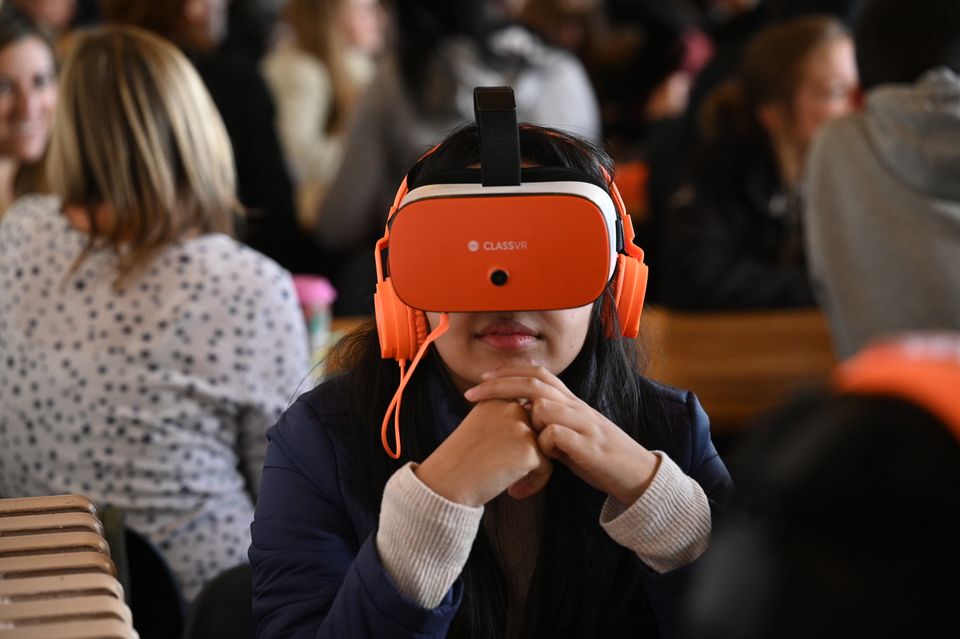
Jennifer Noah teaches STEM at Dalraida Elementary in Montgomery, Alabama. One afternoon, her third graders were studying severe weather. She loaded a VR tornado experience onto their ClassVR headsets. Students put them on and just . . . went quiet. They were inside the tornado, looking around at the debris, completely absorbed. Noah said the engagement was “just amazing to watch.”
That’s immersive learning. Not a video playing in the background while half the class zones out. An experience that students actually remember.
If you’re trying to figure out whether this could work in your school, or you need something concrete to show your team, keep reading. These are all real schools, and none of them had massive technology budgets to start with.
What does immersive learning actually look like in a classroom?
Immersive learning is any approach where students experience a topic rather than just reading or hearing about it. The technology comes in a few flavours:
- Virtual reality (VR) – students wear a headset and find themselves somewhere else entirely. Could be the bottom of the ocean, could be ancient Rome. The classroom disappears.
- Augmented reality (AR) – this one’s a bit different. Students stay in their classroom, but digital 3D models appear in the space around them. A frog on the desk. A beating heart they can turn over in their hands.
- 360-degree environments – panoramic scenes students can look around freely. Think Google Street View, but for a rainforest or the surface of Mars.
- Interactive 3D models – objects students grab, spin, and zoom into using AR cubes. The kind of close-up detail that a textbook diagram can’t match.
All of it puts students in the middle of whatever they’re learning about, rather than reading about it second-hand. And that makes a bigger difference than most people expect before they’ve seen it in action.
PwC ran a study on VR-based soft skills training across 12 US locations. VR learners completed courses four times faster than those in classroom settings and were four times more focused than e-learning participants. Now, that study was about corporate training, so it doesn’t map perfectly onto a classroom of eight-year-olds. But the core finding holds up: when someone’s attention is fully captured, they learn faster. Any teacher who’s watched a class try VR for the first time can confirm that getting attention isn’t the problem. Convincing students to take the headsets off? That’s the problem.
Taking students inside a tornado: STEM and science come to life
Montgomery Public Schools in Alabama is one of the most striking immersive learning examples we’ve come across, and it happened at district scale. The whole thing started because one school decided to try it.
Dalraida Elementary opened STEM labs in 2022 with ClassVR headsets alongside other hands-on technology. Word spread fast.
Montgomery’s superintendent came to see the lab in person, liked what he saw, and made the call to roll ClassVR out district-wide.
| Schools with ClassVR | 41 of 50 Montgomery’s district schools |
| Elementary coverage | Every elementary school in the district |
| STEM labs equipped | All 16 |
| Students with access | 27,400 |
What made the difference wasn’t the novelty. Noah went into classrooms and modelled lessons for teachers, walking them through exactly where VR content lined up with what they were already teaching. Teachers didn’t have to rethink their planning. They just saw where the headsets fitted in.
Noah also tried something with literacy that we thought was particularly smart. Before students started reading a new book, she had them explore VR scenes related to the setting. So by the time they opened the text, they’d already “visited” the place the story was set. “It gave them the background knowledge,” Noah said, “and when they started digging into their stories they were like ‘I saw this back on the headsets!’ so it helped reinforce what they were learning.”
We’ve written up the full Montgomery Public Schools case study if you want the whole story of how it went from one lab to 41 schools.
Students building their own virtual museums in Ohio
Winton Woods City Schools in Cincinnati went about it differently. Their students were already building virtual scenes in CoSpaces as part of project-based learning. The problem wasn’t ambition; it was the hardware. Using VR on phones meant unreliable internet connections, data plan issues, and storage headaches. Then the school discovered ClassVR’s partnership with CoSpaces, and the pieces fell into place.
Here’s the project that got our attention. Students researched World War I, then built their own virtual museums about it in CoSpaces. They designed the rooms, chose what to display, wrote the labels. And then they put on headsets and walked through the museums they’d just created. That’s not watching a VR experience someone else made. That’s building one, and then living in it.
Jennifer Haller, Instructional Technology Consultant at Winton Woods, has plans for special education too. The idea is to film personalised 360 videos of unfamiliar places before visits, so students can explore them first and feel prepared. “We’d love to go and film 360 videos beforehand, add some additional features in CoSpaces and then let our special education students explore them in ClassVR,” Haller said. We think that particular use case, filming a place a student is about to visit so they can explore it safely first, is one of the most underused applications of VR in schools right now.
See how other schools across the country are using ClassVR
What Pennsylvania got right about rolling out VR district-wide
If you’re thinking about how to bring VR beyond a single classroom, Donegal School District in Pennsylvania is worth paying attention to.
Megan Hull-Burg, the district’s Instructional Technology Coach, kept things simple. She’d offer to teach a VR lesson tied to whatever a teacher was covering that week, showing how ClassVR could bring that lesson to life. No complicated pitch. Just “here’s what this looks like with your students.”
“Modelling is the best way to get into classrooms,” Hull-Burg said. “I simply ask the teachers what they’re teaching, I share all the experiences that I can bring to the lesson, and they say ‘When can you come!’”
The Donegal Foundation helped fund the headsets through a grant, something worth looking into if you’re exploring your own funding options. The Foundation described ClassVR as “exactly the kind of thing our foundation looks to facilitate,” because it adds to the curriculum and gives students opportunities they wouldn’t otherwise have.
What’s next for Donegal? Students making their own stuff. The district has 360-degree cameras and wants students filming their own content, uploading it, and viewing it through the headsets. That’s a natural next step, and it’s one we’re seeing more districts plan for once the initial rollout settles in.
How VR is building motivation in computer science and special education
Branden Wells teaches Computer Science across four elementary schools in Salem City Schools, Virginia. He loads ClassVR headsets into the back of his truck and takes them wherever he’s teaching that week.
Wells ties VR directly to the state’s Standards of Learning. When second graders are learning the water cycle in science, he doesn’t just teach it once. He has them code it in Scratch, then experience it through ClassVR. The same concept, revisited three different ways, each one building on the last.
Before this role, Wells worked in special education. VR changed how he was able to reach students who’d switched off from traditional lessons. As he put it, VR takes the learning “from just another textbook, where they’re not interested, to an exciting learning experience.” And those students didn’t just benefit quietly. They became the ones showing their classmates how to use the headsets, walking them through experiences, answering questions. Wells said “It levelled the playing field.”
He wants to take that further. His plan is to host an open evening where students guide their own families through VR experiences. The point? To show parents that VR in schools is an educational tool, not the gaming platform they might associate it with.If you work with students receiving special education services, we’ve got dedicated resources on how VR supports special education with classroom strategies and case studies.
Immersive learning examples across the curriculum
We get asked this all the time: “What subjects actually work with VR?” The honest answer? ALL of them. Here’s what’s happening in schools right now.
| Subject area | What it looks like in practice | Why it works |
| Science and STEM | Third graders standing inside a tornado. Middle schoolers rotating a 3D animal cell in their hands. Students virtually walking through a beating heart. | Concepts that used to live in diagrams become something students can actually investigate. |
| History and social studies | A class in Ohio built a virtual World War I museum. Schools across the country take virtual field trips to places like the Colosseum or the Berlin Wall. | Reading about a historical event is one thing. Feeling like you’re standing in it is something else entirely. |
| Literacy and English | Teachers in Montgomery immerse students in VR scenes before reading. Students then write about what they saw, heard, and noticed. | Background knowledge builds vocabulary. Students who’ve “been there” write with more detail and confidence. |
| Geography | 360-degree views of rainforests, coral reefs, cityscapes, and the solar system. Times Square one minute, the Sahara the next. | No permission slips, no coach hire, no packed lunches. And students remember what they’ve explored. |
| Languages | Students explore Spanish landmarks and cultural sites in VR, then describe what they experienced in the target language. | Beats flashcards. Contextual, sensory-rich practice gives students something real to talk about. |
| Computer science | Wells’s students in Virginia code the water cycle in Scratch, then step into it through ClassVR. | Coding stops being abstract when you can walk through the thing you just built. |
| Career and technical education | Engineering walkthroughs, healthcare scenarios, and vocational simulations, all in a safe virtual space. | Students get hands-on experience with career pathways before they leave school. |
Want to see what’s available for your subject? Browse the Full ClassVR Content Library.
What separates a great VR lesson from a forgettable one?
There’s a common assumption that buying any headsets is the same as implementing VR. The schools in this article would disagree. The type of VR technology mattered, as ClassVR helped them easily intergrate vr into lessons the way no other vr provider could. How?
We tied VR to standards before anything else. Montgomery didn’t introduce headsets and hope teachers would find uses. They mapped VR content to state standards first, so teachers could see exactly where it slotted into lessons they were already running. That’s why it stuck.
We demonstrated, rather than explained. Both Donegal and Salem City Schools sent an instructional technology specialist into classrooms to teach a real lesson with real students. Teachers watched their own classes react. That did more than any PD session or training deck could.
Showed schools how to use in every lesson. Fifteen minutes of VR within a lesson is plenty. Enough to anchor a concept, open a discussion, or set up a writing task. The headsets support the lesson. They don’t become the lesson.
Provided teacher control at the center of the resource. Every teacher in these case studies could see what each student was looking at, pause the experience, and guide the class through it together. That level of oversight is what separates a VR tool built for schools from one built for living rooms. Consumer headsets like Meta Quest don’t offer that, and without it, managing a class of 30 in headsets gets complicated quickly.
What schools did to get up and running
The schools we’ve featured all approached implementation differently, but a few common steps came up again and again.
- They started small. Montgomery’s whole district rollout began with a single STEM lab at Dalraida Elementary. The superintendent visited, saw the engagement for himself, and the expansion happened from there. You don’t need to commit to 50 schools on day one. One strong lesson in one classroom is usually enough to build the case.
- They found funding that already existed. Donegal used a local foundation grant. Montgomery used ESSER funding while it was still available. Plenty of federal programmes can cover educational technology:
- Title I
- Title IV-A
- Perkins V
- IDEA Part B
- Our guide to funding VR in schools walks through how each one applies and what to include in an application.
- They chose VR that was built for classrooms, not adapted from gaming. This came up in every conversation. Consumer headsets like Meta Quest are powerful, but they weren’t designed for a teacher managing 30 students at once. They don’t come with curriculum content, a teacher portal, or centralised device management. The schools that had the smoothest rollout chose a system where all of that was already in place.
- They connected with other schools who’d already done it. If you’d like to speak to a teacher who’s been through the process, or see the technology in action with your own curriculum, Book a Free Demo and we’ll set it up.