
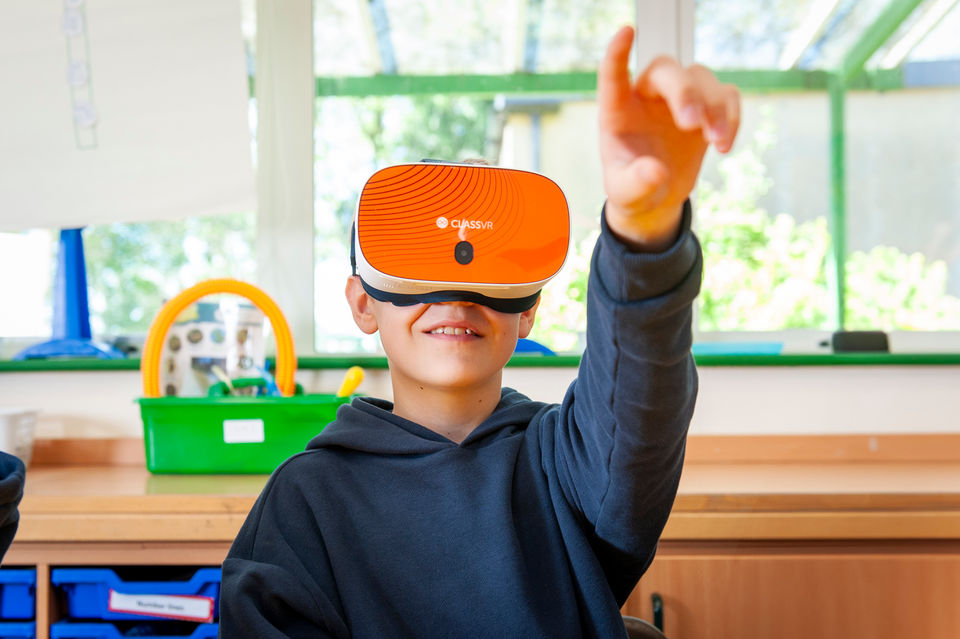
If you teach middle school, its common for Students arrive in the classroom sometimes with big emotions. A group chat that somehow causes more disruption than your entire lesson plan.
That’s exactly why SEL matters at this stage. Not as a Friday afternoon add-on, but as part of how your classroom actually works. Let students arrive to class instantly regulated, reset and ready to learn.
What does the research say? Durlak and colleagues ran a meta-analysis (published in Child Development) across 213 SEL programs. Over 270,000 students. The SEL group scored 11 percentile points higher on academic achievement. Conduct problems went down. Social skills got stronger. All from something that isn’t even designed as an academic programme.
Of course, the tricky part is finding activities that middle schoolers won’t immediately tune out. Introducing EduverseTHRIVE by classVR.
The five CASEL competencies
CASEL breaks SEL into five areas:
- Self-awareness: what am I feeling right now, and what triggered it?
- Self-management: how do I cope when things get stressful without making it worse?
- Social awareness: what’s going on for the person sitting next to me?
- Relationship skills: how do I disagree with someone without it turning into a fight?
- Responsible decision-making: what happens if I actually think this through before I act?
Second Step is probably the most widely used curriculum built around all five. But you don’t need a boxed programme. Most of these skills already have a natural home inside subjects you teach every day.
The activities below are loosely grouped by competency, but most touch two or three at once. Which box an activity fits in matters a lot less than whether it gets your students to stop and reflect.
Self-awareness: getting past “I’m fine”
Teachers see it in class, but cant always get through to students How’s it going?” Shrug. “Fine.” It happens ten times a day. The student isn’t trying to be difficult. They genuinely might not have the words yet. Or maybe nobody’s asked them a question pointed enough to get past the default.
Prompts that actually land.
Generic questions get generic answers. “How are you feeling?” is too easy to brush off. These prompts tend to get students thinking for real:
- “Describe a moment this week when your body reacted to something before you’d even processed what happened.”
- “Write about a time your own reaction caught you off guard.”
- “Name one thing you cared about this week but kept to yourself.”
Yale’s RULER program takes a similar angle with its Mood Meter. It’s a grid: energy on one axis, pleasantness on the other. Students place themselves on it and look for a feeling word that matches. Over time, “fine” gets retired. “Frustrated” shows up. “Restless” shows up. “Actually OK today” shows up. Those words give students a way to talk about their inner life that “fine” never did.
Character maps and body check-ins.
Here’s one that works because of a small trick. You tell students they’re going to map a fictional character: motivations, fears, flaws, strengths. Then you reveal the character is them. The fictional setup lets them be more honest than they’d ever be in a direct “tell me about yourself” activity. Something about the distance makes it safe.
Body check-ins are the simplest thing in this whole post. Between activities, pause for 30 seconds. Jaw tight? Shoulders creeping upward? Fists clenched? Nobody has to share. Nobody has to close their eyes. It’s just a quick scan. And once it becomes habit, students start noticing their own tension before it spills over into behaviour.
Self-management: small, practical tools
EduverseThrive content library MyThrive, is a personal virtual space to support studetns reset, regulate, and return ready to learn, in a way that works for them.
MyTHRIVE gives learners a safe, personalised space to pause when things feel overwhelming, regulate emotions and sensory input, and explore freely when curiosity takes the lead, supporting a calm, confident return to learning. The EduverseThrive Bundle allows the students that need it most have there own headsets, so it can be treated it like any other routine. Don’t make a big thing of it. After a couple of uses, most students start doing it without being asked. mimising distruption to learning.
Other ideas to make self management stick:
- Accountability partners: a friend asking “did you actually do it?” on Monday morning carries more weight than any teacher check-in
- Targets you can count: “I’ll raise my hand twice in science this week” works because a student can track it. “I’ll try harder” doesn’t mean anything concrete
- A fresh start every week: set Monday, review the following Monday, pick a new one
The stress toss is worth a go, too. Write whatever’s bugging you on a scrap of paper, scrunch it up, bin it. Takes 60 seconds. Sounds too simple to work. We’ve tried it in a few classroom settings and students genuinely seem to reset, enough to refocus, at least.
Social awareness: building real empathy
Every school has that laminated poster near reception about being kind. Students barely glance at it, and fair enough. Reading about empathy doesn’t build it any more than reading about swimming gets you across a pool.
Three activities that actually work:
- Perspective-writing: give students a scenario. Have them write it from Person A’s point of view, then swap and write it from Person B’s. Having to construct someone else’s reasoning from the inside is where real empathy develops.
- Discussion cards: “Your friend is talking behind another classmate’s back and wants you to join in. What do you do?” No neat answer exists. The value is in the conversation: hearing how classmates reason through it, noticing where your instinct and theirs pull apart.
- Immersive learning: being in the persons shoes, living and breathing what they are seeing through immersive learning tools, like VR leads them to gain understnading and naturally build empathy.
How immersive learning truly builds empathy
A teacher can describe sensory overload in careful detail. But the student hearing it is still imagining it from the outside. There’s a gap between understanding something and feeling even a version of it.
VR closes that gap. ClassVR lets you place students inside expert-curated 360° scenes, 3D models, and immersive videos help learners explore perspectives, social situations, health and wellbeing, and real-world contexts, supporting empathy, acceptance, and shared understanding in the classroom
A 2024 systematic review in Multimedia Tools and Applications looked at 37 studies on VR and empathy. More then 50% found statistically significant improvements. The consistent finding: VR enables perspective-taking at a depth other methods can approximate but rarely match.
EduverseTHRIVE, ClassVR’s wellbeing and inclusion library, is built for exactly this, Expert-curated 360° scenes, 3D models, and immersive videos help learners explore perspectives, social situations, health and wellbeing, and real-world contexts, supporting empathy, acceptance, and shared understanding in the classroom
You control everything through the ClassVR portal. Adding a perspective-taking experience to a diversity lesson takes about a minute. Any tool that needs 20 minutes of prep won’t survive a packed school day.
Life skills: connect, disagree, repair
Three things matter at this age: connecting and understanding genuinely, having confidence in actions and decisions. Most SEL materials only cover the first one.
The compliment web works for connection. Circle up, toss yarn, name something specific you appreciate about the catcher. “I noticed you helped Jayden without being asked” pushes students into genuinely observing each other. “You’re nice” doesn’t count.
Collaborative problem-solving gets at different skills. Small groups, a task with real constraints, then a debrief: who led? Whose idea got shut down? How did the group handle it? The debrief is where the learning sits.
The bit most programmes skip: repair.
Restorative practice gives students a framework:
- Name what you did. Specifically. “I laughed at your idea in front of everyone.”
- Acknowledge the impact. Ask them how it felt. Use their words, not yours.
- Commit to something different. “Next time I disagree, I’ll say it privately,” not a vague “I’ll be nicer.”
Practise with silly low-stakes scenarios first. A borrowed pencil that vanished. A forgotten seat at lunch. When real conflict shows up (give it a week), students already have a script in their heads. They don’t have to invent an apology under pressure.
Responsible decision-making: the grey areas
The choices that test middle schoolers aren’t the obvious ones. Money on the floor with nobody watching. A mate who wants you to cover for them. Someone clearly copying during a quiz. No correct answer printed on the back.
Give students support by teaching them to ask themselves the four questions help students build a thinking reflex:
- What happens with each option, best case and worst?
- Who else is involved? How would they tell this story?
- Flip it: if you were on the other end, what would you hope the other person does?
- Have you considered every option, or just the obvious ones?
Classroom debates are brilliant for this, especially when you make students argue the side they disagree with. Defending your own view is easy. Building the strongest case for a position you’d normally reject stretches empathy and critical thinking at the same time.
Activities mapped to CASEL competencies
| CASEL competency | Activity | Why it works |
| Self-awareness | Emotion journals | Specific prompts get past “I’m fine” |
| Self-awareness | Character maps | Safe distance through fictional framing |
| Self-management | Three-breath reset | Quick pause between feeling and reacting |
| Self-management | Accountability partners | Peer check-ins outperform teacher ones |
| Social awareness | VR empathy experiences | Perspective-taking at depth discussion can’t match |
| Social awareness | Perspective-writing | Building someone else’s logic deepens empathy |
| Relationship skills | Collaborative problem-solving | Real-time practice in communication and conflict |
| Relationship skills | Apology frameworks | Structure replaces the mumbled “sorry” |
| Decision-making | “What if” analysis | Builds the habit of thinking through consequences |
| Decision-making | Classroom debates | Arguing the other side strengthens critical thinking |
Making SEL stick
One-off lessons don’t change much. The schools where SEL actually takes hold thread it through the whole day:
- A two-minute morning check-in: body scan, Mood Meter, or a one-word go-round
- VR for in the moment regulation
- Scenario conversations folded into existing subjects
- A quick end-of-day reflection: one thing that went well, one that tested you
- Monday accountability partner check-ins until they become automatic
CASEL’s schoolwide guide backs this up: daily consistency across the school is what shifts culture.
ClassVR fits because EduverseTHRIVE was designed for in-the-moment use. Student comes back from break visibly wound up? Headset on, two minutes in a calming space, headset off, back to the lesson. Midway through a diversity unit and want to add perspective-taking? Two clicks and the experience is ready.
Where to go from here
Start narrow. One competency. Two or three activities that feel right for your students. Run them consistently for a full semester, then watch for the quiet shifts: smoother group work, faster conflict resolution, journal entries that go somewhere honest. Those signs matter more than any behaviour chart.
If you’ve got ClassVR or you’re exploring it, EduverseTHRIVE adds a ready-built SEL layer without extra planning. The content’s built by education specialists, the portal gives you full control, and nothing requires a timetable overhaul.
You’re reading this after a full day of teaching. That says plenty about where your priorities are. The right activities, used consistently, will give your students skills that stick long after they’ve left your room.