
.png?tr=w-960)
Science, technology, engineering, and math are curriculum staples that students are expected to learn, retain, and apply well beyond the classroom. Yet with only a textbook to work from, experiences like dissecting a heart, exploring the surface of Mars, or watching a chemical reaction unfold molecule by molecule rarely stick in a way that survives to exam day.
Virtual reality closes that gap.
Since 2020, VR has moved from a novelty way to take a “virtual field trip” into something schools across the US use daily to teach STEM subjects. Six years on, a growing body of academic research backs up what teachers have long suspected: when students can see, touch, and explore a concept in 3D, what they learn is more likely to stick.
Below, we break down the evidence-backed benefits of VR in STEM education, how it works in a live classroom, and how schools are funding ClassVR.
Deeper Engagement With Abstract Concepts
Some STEM concepts are hard to grasp simply because they’re too small, too large, too complex, or impossible to observe directly. Atomic structures, planetary orbits, cell division, and electrical currents are all topics students commonly struggle to picture from theory alone.
VR makes the abstract visible. A textbook diagram can only be described; in VR, a student can hold a concept in the palm of their hand, rotate it, and manipulate it. That means stepping inside structures, systems, and processes in 3D – from cells and anatomy to forces, environments, and engineering systems – and connecting the theory to something they can see and interact with directly.
A 2025 systematic review of 117 studies on VR and AR in K-12 STEM learning, published in Education and Information Technologies, found consistent evidence that immersive tools have a measurably positive effect on both individual learners and the broader teaching and learning process – particularly in science, which was the most heavily researched subject area, accounting for 77 of the 117 studies reviewed. That’s engagement with a research paper trail behind it, not just anecdote.
Better Retention Through Hands-On Learning
Passive learning of listening, reading, note-taking – is notoriously fragile when it comes to STEM education that builds concept on concept. For example If a student doesn’t retain photosynthesis, cellular respiration is going to be a struggle.
Immersive, “learn by doing” environments engage multiple senses at once, which supports stronger encoding and recall than a slide deck or diagram. A 2025 systematic review in Computer Applications in Engineering Education looked at VR and AR use across engineering education and found real potential to support learning outcomes – but only when the technology is deliberately aligned to clear pedagogical goals rather than deployed as a novelty add-on. That’s a distinction that matters when schools are choosing curriculum-aligned content over generic apps.
Safe, Repeatable Hands-On Experiments
Not every experiment is safe, affordable, or even physically possible in a school science lab, and the time available for practical work is under pressure. The most recent National Assessment of Educational Progress found that US students’ enjoyment of science activities dropped from 52% to 42% between 2019 and 2024, alongside a wider decline in 8th grade science scores. A trend many teachers link to reduced hands-on lab time, partly a legacy of pandemic-era restrictions on shared equipment.
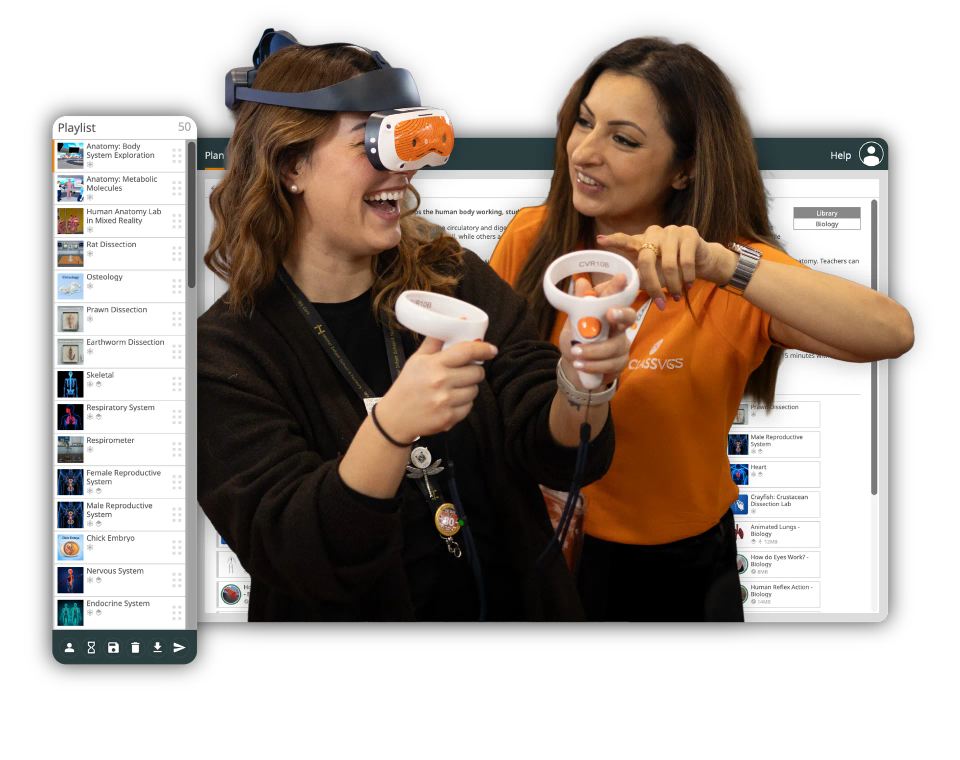
VR removes some of that constraint. Students can run chemistry experiments, complete dissections, and build and test their own robots and circuits – repeating an experiment as many times as they need, or moving on to a harder variant once they’ve mastered the basics.
This is where immersive content libraries matter as much as the headsets themselves. The EduverseSTEM content available with Xcelerate, gives students 500+ Virtual STEM experiences, from virtual dissections to coding, to chemistry experiments and more, going far beyond what a static diagram or video can offer.
Equal Access to Field Trips and Real-World Experiences
Field trips are expensive, logistically difficult, and often entirely out of reach for rural or underfunded schools. VR gives every student – regardless of ZIP code or transport budget – the same access to the Great Barrier Reef, the International Space Station, or the surface of Mars.
That levels the playing field in a way physical logistics simply can’t, particularly for Title I schools where a single off-site excursion might consume a meaningful chunk of the annual budget.
Stronger Career Awareness in STEM Pathways
Beyond core content, VR is increasingly used to connect classroom learning to real STEM careers, letting students “try on” roles as engineers, scientists, or technicians through realistic simulations – content Avantis packages as CareerHub within Eduverse+. Building that early sense of “I could actually do this job” has a measurable effect on confidence and interest in pursuing STEM pathways further into their education.
Montgomery Public Schools in Alabama is a useful real-world example. After piloting ClassVR in a single elementary STEM lab, the district used ESSER funding to scale the program district-wide, purchasing 80 headset carts now in use across 41 of its 50 schools – including every elementary school and all 16 dedicated STEM labs – citing gains in both engagement and standards-aligned outcomes (see the full case study).
Support for Diverse Learners
VR isn’t a one-size-fits-all tool, and that’s precisely its strength in a mixed-ability STEM classroom. Visual and kinesthetic learners who struggle with text-heavy instruction often thrive when a concept becomes something they can see and interact with. For students with additional needs, VR can also offer calming, controllable sensory experiences or scaffolded practice that reduces pressure compared with a live classroom setting.
A 2026 study in Frontiers in Education examining VR and AR use in mathematics and chemistry classrooms found students reported high behavioral intent to keep using the tools and made statistically significant learning gains compared with a control group taught conventionally (Frontiers, 2026) – evidence that the benefit isn’t limited to any one learner profile.
Data-Backed, Not Just a Trend
It’s fair for school leaders to be skeptical of edtech that promises the world. But VR in STEM has moved past the hype-cycle stage. A 2025 framework paper published in Applied Sciences synthesized recent scholarship, US policy reports, and case studies on K-12 STEM VR adoption, proposing a structured five-phase framework for schools rolling it out – evidence that the research community is now focused on how to implement VR well, not just whether it works (MDPI, 2025).
That said, the same research is honest about the caveats: successful implementation depends on curriculum alignment, sustained teacher training, and realistic session lengths – not just handing out headsets. Built-in classroom management and lesson planning tools are what make VR sustainable in a real timetable, rather than a one-off novelty lesson.
How Schools Are Funding VR for STEM
Cost is usually the first objection school leaders raise – and usually the first myth to bust. In the US, VR hardware and STEM content can typically be funded through existing federal and state programs, including:
- Perkins V grants for career and technical education pathways
- Title I and Title IV-A funding for technology that supports instruction and achievement
- IDEA Part B funding, where VR supports accessibility and individualized learning
- State EdTech grants and district technology budgets, including any remaining ESSER-successor funds
Full eligibility details and program-by-program breakdowns are covered in the ClassVR grants and funding guide and the more detailed funding walkthrough for VR in schools, including what grant reviewers typically look for in a proposal.
Getting Started With VR in Your STEM Classroom
If you’re weighing up whether VR is worth introducing to your STEM department, the research consensus is encouraging but not unconditional: the technology works best when it’s curriculum-aligned, teacher-supported, and used purposefully rather than as a gadget. Start by looking at how similar schools have implemented it – the ClassVR case studies library is a good place to see real STEM labs in action, from elementary science to secondary CTE pathways, alongside the full range of VR headsets built for education.
Frequently Asked Questions
Does VR actually improve STEM learning outcomes, or is it just more engaging?
Both, according to current research. Multiple peer-reviewed studies point to real improvements in conceptual understanding and retention, not just novelty-driven engagement – though outcomes depend heavily on how well the VR content is aligned to curriculum and learning objectives.
What STEM subjects work best with VR?
Science has the strongest evidence base, particularly biology, chemistry, and physics, followed by mathematics and integrated STEM/engineering content. Anything involving spatial reasoning, microscopic detail, or experiments that are expensive or unsafe to run physically tends to benefit most.
How long should a VR session last in a STEM lesson?
Most ClassVR schools find that shorter, focused sessions – commonly around 10 to 15 minutes – work best for introducing or reinforcing a concept, rather than replacing an entire lesson. VR performs best as a supplement to core teaching, not a substitute for it.
Can VR support students with additional needs in STEM classes?
Yes. VR can offer more controlled, self-paced, and multi-sensory ways to engage with STEM content, which can benefit students receiving special education services, English language learners, and students who struggle with traditional text-heavy instruction.
How can US schools pay for VR headsets and STEM content?
Federal programs such as Perkins V, Title I, Title IV-A, and IDEA Part B, along with state EdTech grants, are commonly used to fund VR hardware and curriculum content, especially when the purchase is tied directly to student outcomes or career and technical education pathways.
Is VR proven to work, or is it still an experimental technology?
It’s increasingly proven. Academic research has shifted from asking whether VR helps STEM learning to studying how best to implement it at scale — a sign the underlying evidence base is now considered fairly well established, even as best practices continue to evolve.